SeattleRoadside Assistance (206) 483-2704

Towing and Roadside Assistance in Seattle, WA

A car that will not start, a tire that cannot be saved, an ordinary breakdown on I-5 at rush hour. This page covers towing for cars and light trucks in the Seattle area, taken to the shop or the driveway you pick.

Roadside Assistance Emergency Line(206) 483-2704

Call DispatchOr fill in a breakdown ticket

What moves the quote

Have this ready when you call

  1. Your location: street and cross street, or freeway direction and nearest exit, or the garage name and level
  2. The make, model and year, and whether the car is all-wheel drive or lowered
  3. Where you want the car taken, with the shop name or cross streets
(206) 483-2704

What does towing and roadside assistance cover in Seattle?

Towing and roadside assistance here means cars, crossovers, SUVs and light pickups, moved to the shop or home you name. It does not cover box trucks, buses or heavy equipment. If you are unsure that your vehicle qualifies, describe it on the call.

Most calls on this line involve an ordinary passenger vehicle that quit on a Seattle street, in a parking lot or on a freeway shoulder. A sedan with a dead transmission, an SUV with an overheated engine and a pickup with a broken axle all count as light-duty. Dually trucks, vehicles pulling trailers, motorhomes and work vehicles with large bodies are a different class of job, and this line does not claim them. Tell the operator the make, model and year, whether the vehicle is lowered or raised, and whether anything is hanging loose underneath. Those details decide which truck goes out, so the quote you hear is for the truck that actually shows up. Other roadside jobs, such as mobile tire repair, a flat tire change or a jump start, have their own pages.
Flatbed or wheel-lift: which tow does my car need in Seattle?

A flatbed carries the whole car on a level bed, and a wheel-lift raises two wheels while the other two roll. Flatbeds suit low, all-wheel-drive and damaged cars. Wheel-lifts work for many cars that roll freely.

A flatbed is the gentler choice, since all four wheels sit off the ground and nothing drags. It is the right pick for cars with low front bumpers, for any car with a damaged wheel or axle, and for all-wheel-drive models. A wheel-lift slides under the front or rear tires and lifts that end. It sets up quickly in tight spots, such as a downtown garage ramp where a long flatbed may not clear the turn or the posted height. The catch is that the two wheels left on the ground must turn freely. Steep streets matter too: a car on a Queen Anne or Capitol Hill grade needs a truck that can load it without rolling. Say what happened to the car, and the right truck gets sent.

Can an all-wheel-drive car be towed in Seattle?

Yes, but it should go on a flatbed with all four wheels off the ground. Pulling an all-wheel-drive car on two wheels can damage the drivetrain. Tell the operator your car is all-wheel drive when you call.

All-wheel-drive systems link the front and rear axles, so turning only two wheels while the other two sit still can strain the center differential or transfer case. Many owner's manuals say the same: flatbed only. The same caution applies to many four-wheel-drive trucks and to some electric cars, whose motors can be harmed if the wheels spin without power. Your manual usually has a towing section that says what is allowed, and it is worth reading before the truck gets there. If you cannot find it, the make, model and year are enough for the operator to look it up. The operator asks about drive type and about the wheels, and if a flatbed is needed, the quote you hear already includes it.

Where can I have my car towed in Seattle?

Anywhere reachable by road that you choose: a repair shop, a dealer, a tire shop or your own driveway. You pick the destination, and the distance is part of the quote. Have the shop name or the cross streets ready.

People often call from the roadside without a plan. A shop that is open late, a dealer that services your brand or a garage a friend recommended all work. If you choose a shop, check that it is open, or that it accepts cars left in its lot overnight, because a locked gate on arrival wastes your time. Many drivers choose home, so a repair can be arranged the next day. If the trouble is only a tire, say so: a tire shop can be the destination, or a mobile tire repair at the roadside may make the tow unnecessary. A destination across the I-90 or SR-520 floating bridge, or south in Tukwila or Renton, changes the distance and the quote.

What if my car dies in the SR-99 tunnel or on I-5 in Seattle?

Call 911 first, stay belted in and keep the hazards on. The SR-99 tunnel is about two miles long with no mid-tunnel entrances or exits, so a stopped car has nowhere to turn off. Call the roadside line after help is on the way.

On I-5, I-90 and SR-99, a stopped car is a hazard to everyone behind it. In the tunnel, do not try to fix or push anything. Note which direction you were driving and the last exit or sign you saw. On open freeway, the right shoulder is the safest place if the car still rolls. Once emergency crews have the scene under control, a light-duty tow can move the car to the shop you pick, and the quote comes on the call before a truck is sent. A car that sits in a lane can also be moved by the agency that manages the road, which is a separate matter from your own call.

How is a Seattle tow quoted?

Every tow is quoted on the call, before a truck is sent. The quote depends on the type of truck, the distance, the hour and where the car sits. Call (206) 483-2704, give the details, and you hear one answer to accept or decline.

A car in a driveway on a flat street is a simple load. A car nose-down in a ditch, on a narrow freeway shoulder or on the third level of a garage takes more work, and the quote reflects that. Distance matters, and so does an after-midnight call. All-wheel-drive cars need a flatbed, which can change the number too. The operator adds these up while you talk and gives you a single answer. There is no membership, and no one is sent until you say yes. If you decline, you can call back when you are ready. The number you agree to is the number for that job, so confirm the destination before you hang up.

What if my car was towed by police or from a lot in Seattle?

That is a separate matter. Police-ordered tows and private-lot tows are handled by the agency or the lot owner, not by this line. Start with the signs at the lot or the agency that ordered the move.

If a car vanished from a street or a parking space, first look for a posted sign that names the towing company. For a car moved by police, the department that ordered the tow can tell you where it went. Those cars go to a storage yard that sets its own rules, and this line has no say in the fees or the release. What this line can do is tow your own car from a spot you choose, such as a shop or your home, when it will not run. If your car was moved and you need a ride to the yard, that is also outside this service. Have your plate number and vehicle description ready when you call whoever holds the car.

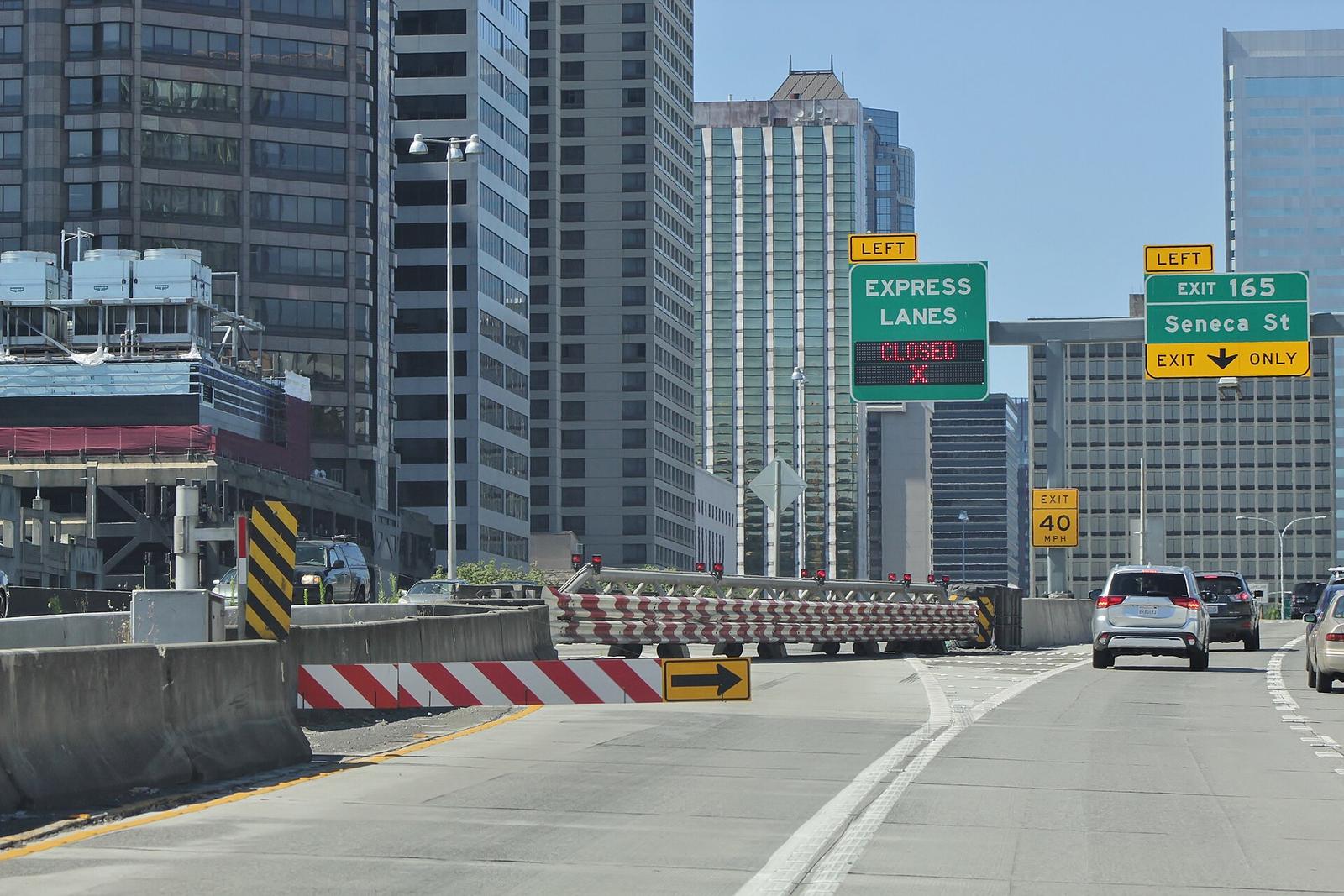
The northbound I-5 express lanes entrance at Seneca Street, closed, with downtown towers around it
The I-5 express lanes entrance at Seneca Street.

Write it down before you dial

Fill in the ticket and tap send. It goes to the local operator's phone as a text, and they call you back on the number you give. In a hurry? Call (206) 483-2704 instead.

On a freeway, tap the road and your direction, then add the nearest exit or cross street. That is enough for the operator to find you.

Roadside Assistance Emergency Line(206) 483-2704

Breakdown ticketSeattle, WA

On a freeway? Tap the road, then the direction

Seattle and the towns around it

Calls come from every part of Seattle and from Shoreline, Burien, Tukwila, SeaTac, Renton, Mercer Island and Bellevue. Travel to the far edges of the county is part of the quote you hear on the call.

  • SeattleKing County · home base
  • ShorelineKing County · north on I-5 and Aurora Avenue
  • BurienKing County · south on SR-509
  • TukwilaKing County · south where I-5 meets I-405
  • SeaTacKing County · south by the airport
  • RentonKing County · southeast on I-405
  • Mercer IslandKing County · across the I-90 floating bridge
  • BellevueKing County · east across SR-520 and I-90

Town-by-town coverage, with a map for each

Call (206) 483-2704Call