SeattleRoadside Assistance (206) 483-2704

Flat Tire in the Rain in Seattle: What to Do and Where Your Spare Is

A flat in the Seattle rain is stressful, and the first seconds matter most. Here is how to get off the road, what to do on a hill or in the dark, where your spare and jack probably are, and when to call 911 before you call for roadside help.

Roadside Assistance Emergency Line(206) 483-2704

Call DispatchOr fill in a breakdown ticket

Have this ready when you call

  1. Your direction and the nearest exit or cross street
  2. Which tire is flat, and any damage you can see
  3. The wheel lock key, if the car has locking lug nuts
(206) 483-2704

What should I do first if I get a flat tire in the rain in Seattle?

Hold the wheel firmly, ease off the gas, turn on the hazards and steer to the right shoulder or the next exit. Do not brake hard on wet pavement. Once stopped, stay belted in with the doors locked and call.

A blowout feels like a sudden thump and a pull toward the damaged corner. Keep both hands on the wheel and let the car slow by itself. On wet pavement a hard stab at the brake can send the car sideways, so ease down. Washington State Patrol troopers say that if the car can still move, get it to the shoulder or off at the next exit, and tell dispatch where you are headed. On a stretch with little room, such as the approach to the Ship Canal Bridge, roll slowly to the first wide spot or the next exit rather than stopping in a lane. Once stopped, set the parking brake and keep the engine off. Leave the hazards flashing. Do not get out on the traffic side. Call the roadside line and give your direction, the nearest exit and what you can see.
Should I stay in the car or get out on a Seattle freeway shoulder?

Usually stay in the car with your seat belt on, hazards flashing, and call for help. Washington State Patrol troopers have advised exactly that for a disabled vehicle. Get out only if you fear being hit from behind, and then move well away from the road.

A freeway shoulder puts you a few feet from fast traffic, and wet pavement makes a bad situation worse. A car sitting on a jack can slip, and a driver stepping out to wrestle with a lug wrench is exposed to everything passing by. On I-5, SR-99 or the I-405 ramps, the safest choice is to stay put and let a truck come to you. If you are on a quiet side street or in an empty lot on level ground, changing the spare yourself is reasonable. Never jack the car on a slope, soft shoulder or wet gravel, and never crawl underneath. If the tire still holds air, drive slowly to the next exit and stop on a level side street. Then either follow the owner's manual or call the operator. If the spare is flat too, calling is the only choice.

What does Washington's move over law mean for a stopped car in Seattle?

RCW 46.61.212 tells drivers to change lanes or slow down for stopped emergency vehicles, tow trucks with flashing lights and roadside-assistance vehicles with 360 degree warning lights. Plenty of drivers still pass close, so stay inside the car.

The law exists because people working beside stopped vehicles get hit. On a road with at least two lanes going the same way, a driver approaching must change lanes or move away from the lane or shoulder the vehicle occupies, if it is safe. If that is not safe, the driver must slow to at least ten miles per hour below the posted limit. On a road with fewer lanes, the driver slows and passes at a safe distance. A fine of twice the usual amount applies, and it cannot be waived or reduced. On a busy stretch of I-5 or Aurora Avenue, stay in the car with your seat belt on until help is parked behind you. Once a truck is in place, work happens on the side of the car away from the lanes.

Can WSDOT or 911 help with a flat tire on a Seattle highway?

On a state highway you can call 911 for a flat tire, and 911 dispatches the right responder, including a WSDOT Incident Response Team. Those teams help drivers with flat tires and fuel on state highways. A roadside call covers the cases where no patrol truck is near.

WSDOT describes its Incident Response Team work as ranging from helping drivers with flat tires or running out of gas to major traffic incidents. WSDOT's page does not list hours, and it does not name every road the teams cover, so ask the 911 dispatcher what is available where you are. On a city street in the Rainier Valley, 911 can still send help, and the roadside line is the practical move. If a WSDOT truck does stop, accept the help, and call the line for anything it does not cover. On the rebuilt SR-520 floating bridge, WSDOT says the wide shoulders are meant to keep stalled cars out of the travel lane, and its response teams can help without blocking traffic.

Where is the spare tire and jack on most cars?

On most sedans and SUVs the spare lives under the trunk floor, and the jack and lug wrench sit in side compartments next to it. Pickups often hang the spare under the bed. Some newer cars carry no spare, only a sealant kit.

Lift the trunk floor panel and look for a round cover or a large wing nut in the middle, which holds the spare in place. Foam blocks along the sides usually hide the jack and the lug wrench. Pickups and some SUVs keep the spare under the rear, lowered with a crank that you reach through a hole in the bumper or bed. Vans may store it behind a side panel. The owner's manual shows the exact place and the marked lift points on the frame. Many cars from the last decade swapped the spare for a tire inflator kit to save weight, and some use run-flat tires. Check before you need it. Pull out the spare, check its air and find the wheel lock key. A garage in Capitol Hill is a better place to learn that than a wet shoulder.

What should I do about a flat tire on a hill in Seattle?

If the tire still holds air, roll slowly to flatter ground instead of stopping on the steepest part. If you must stop, set the parking brake and turn the front wheels so a roll goes into the curb, not into traffic. Then call.

The Washington driver guide teaches the wheel rule. Facing downhill, turn the front wheels toward the curb. Facing uphill with a curb, turn them away from it, so the car rolls back against the curb. Facing uphill with no curb, turn them toward the road edge. Set the parking brake in every case. Queen Anne, Capitol Hill, the Madison Street climb and the streets down to the Ballard locks all have grades where this matters. Do not jack the car on a slope. A car on a jack can roll off it, and wet pavement makes a slide worse. Tell the operator the street, the cross street and which way the car faces. A photo of the tire and the curb helps. If a flatter spot is a block away and the tire holds air, creep there on the hazards at walking speed.

How do rain and early dark change what I do with a flat tire in Seattle?

Stay visible and stay put: hazards on, dome light on, doors locked, seat belt fastened. Rain cuts how far other drivers can see you, and in December the sun is down before half past four. Do not stand behind the car to wave at traffic.

A stopped car in a dark rain is hard to see until a driver is close, and wet pavement adds to the distance a car needs to stop. Turn the hazards on early, not late, and leave the interior light on so the car shows up and the truck can find it. Do not stand behind the car to wave at traffic. A driver who sees you late cannot stop in time. Wet footing also makes a jack less stable, which is one more reason to wait for the truck when the tire went flat on a shoulder. Keep your phone charged and say so first if the battery is low. Have your keys, registration and the wheel lock key ready.

Should I call 911 or a roadside line about a flat tire in Seattle?

Call 911 first if the car is stopped in a travel lane, anyone is hurt, or you feel unsafe where you are. For a car parked safely on a shoulder or in a lot with nobody hurt, call the roadside line for the tire.

A flat tire alone is not a 911 emergency, but a car blocking a lane of I-5 or a driver shaken up by a blowout is. Dispatchers can get responders moving and get traffic slowed ahead of you. Once you are safe, a second call to the roadside line sorts out the tire. Give the operator your direction of travel, the nearest exit or cross street, and which side of the road the car is on. If you are on a state highway and are not sure which call to make, 911 can tell you what help is nearby. If the car is off the road, nobody is hurt and you are warm and dry, the roadside line is the faster route to a spare on the wheel.

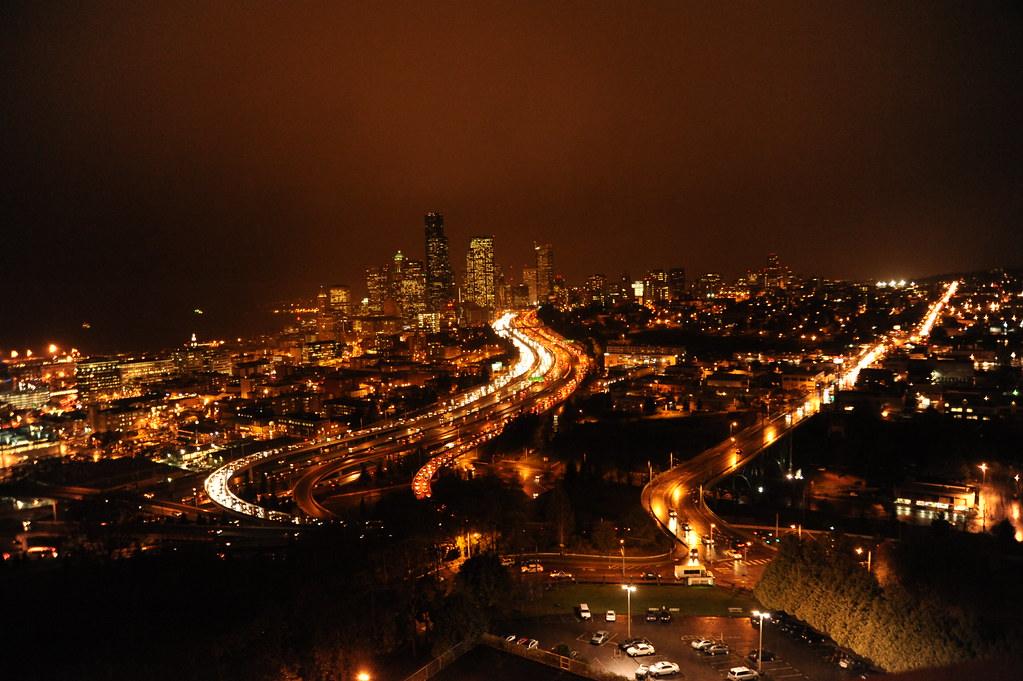
Rain over downtown Seattle at night, with freeway lights below
Rain over downtown at night. The line is answered at any hour.

Where the spare and the jack usually are

Spares hide in different places by vehicle type. The owner's manual has the exact spot for your model, in the section on flat tires.

VehicleSpare tireJack and wrench
Sedan or hatchbackUnder the trunk floor, often under a cover panelIn a foam tray beside the spare or a trunk side panel
SUV or crossoverUnder the cargo floor, under the rear of the vehicle, or on the rear doorCargo-area side panel or under the floor
Pickup truckHanging under the bed near the rear bumper, lowered by a crank rodOften behind or under the rear seat
MinivanOn a cable under the middle of the vehicle, reached from insideA rear side panel or a floor compartment
Newer car with no spareAn inflator kit: a small compressor and a bottle of sealantNo jack; check for run-flat tires in the manual

Write it down before you dial

Fill in the ticket and tap send. It goes to the local operator's phone as a text, and they call you back on the number you give. In a hurry? Call (206) 483-2704 instead.

On a freeway, tap the road and your direction, then add the nearest exit or cross street. That is enough for the operator to find you.

Roadside Assistance Emergency Line(206) 483-2704

Breakdown ticketSeattle, WA

On a freeway? Tap the road, then the direction

Seattle and the towns around it

Calls come from every part of Seattle and from Shoreline, Burien, Tukwila, SeaTac, Renton, Mercer Island and Bellevue. Travel to the far edges of the county is part of the quote you hear on the call.

  • SeattleKing County · home base
  • ShorelineKing County · north on I-5 and Aurora Avenue
  • BurienKing County · south on SR-509
  • TukwilaKing County · south where I-5 meets I-405
  • SeaTacKing County · south by the airport
  • RentonKing County · southeast on I-405
  • Mercer IslandKing County · across the I-90 floating bridge
  • BellevueKing County · east across SR-520 and I-90

Town-by-town coverage, with a map for each

Call (206) 483-2704Call